India’s Golden Triangle: Delhi, Agra and Beyond
India is one of those places that can be difficult to describe to someone who hasn’t experienced it. It’s beautiful and chaotic, historic and modern, exhausting and exhilarating—often all at the same time.
The classic Golden Triangle connects Delhi, Agra and Jaipur, three cities that offer an incredible introduction to northern India. Our route extended a little farther west to Jodhpur before taking us through Jaipur, Delhi and finally Agra, home to one of the most recognizable buildings in the world.
There is an almost overwhelming amount to see along the way. These were some of the places that stood out to me most, along with a few things I’d do differently next time.
Delhi
Delhi can be a lot.
The traffic, noise, crowds and sheer scale of the city hit you almost immediately. But tucked within that chaos are extraordinary pieces of Indian history—and a few surprisingly peaceful places to escape from it.
Gandhi Smriti — Birla House
Of everything I saw in New Delhi, Gandhi Smriti may have been my favorite.
Formerly known as Birla House, the large home sits in one of New Delhi’s wealthier neighborhoods and was where Mahatma Gandhi spent the final months of his life.
Today, the property is a museum dedicated to Gandhi. You can walk through the room where he stayed and see exhibits documenting his life and philosophy. But the most memorable part for me was outside.
Gandhi held daily prayer meetings in the gardens, joined by local residents. On January 30, 1948, he left the house and began walking toward one of those gatherings when he was assassinated.
Visitors can follow his final footsteps from the house into the gardens.
Despite being in the middle of an enormous city, the property feels remarkably quiet. It’s one of those places where knowing what happened there makes the experience far more powerful than simply seeing another historic building.
A Weekend Abroad tip: Give yourself enough time to walk through both the house and gardens rather than treating this as a quick photo stop.
Humayun’s Tomb
If Humayun’s Tomb looks vaguely familiar when you first see it, there’s a reason.
Built decades before the Taj Mahal, the 16th-century mausoleum helped establish an architectural style that would eventually culminate in the Taj. The symmetry, enormous central dome, red sandstone and white marble details all offer hints of what would come later.
But one of my favorite things about Humayun’s Tomb was simply its setting.
The formal gardens surrounding the mausoleum provide a welcome escape from Delhi’s traffic and crowds. After spending time navigating the city, walking through the grounds feels almost restorative.
If you’re planning to see the Taj Mahal later in your trip, visiting Humayun’s Tomb first also gives you an interesting architectural preview.
Lodhi Gardens & Safdarjung’s Tomb
We didn’t have enough time to visit Lodhi Gardens or Safdarjung’s Tomb, but both came highly recommended by locals.
They’re relatively close to Humayun’s Tomb, making this part of New Delhi particularly easy to explore together if you have enough time.
If I returned to Delhi, both would be high on my list.
Chandni Chowk
Then there is Chandni Chowk.
If the gardens and monuments of New Delhi show you one side of the city, Chandni Chowk shows you something completely different.
Located in Old Delhi, this enormous market district is crowded, noisy, colorful and wonderfully chaotic. Shops spill toward the street, rickshaws squeeze through impossibly narrow gaps, vendors sell everything imaginable, and people seem to be moving in every direction at once.
It can also become overwhelming quickly.
I’d recommend visiting in the morning, ideally before the crowds and traffic reach their peak later in the day.
And hire a cycle rickshaw.
Chandni Chowk is far larger and denser than it initially appears, and trying to see everything on foot can quickly become exhausting. Riding through the market also becomes part of the experience itself.
Don’t expect tranquility here. The reason to visit Chandni Chowk is precisely the opposite.
Agra
Seeing the Taj Mahal at Sunrise
There are certain landmarks you’ve seen so many times in photographs that you wonder whether seeing them in person can possibly live up to the expectation.
The Taj Mahal does.
And if you’re going to see it, wake up early.
Arriving around sunrise gives you a completely different experience from visiting later in the day. The temperature is cooler, the crowds are generally lighter, and the changing morning light transforms the marble.
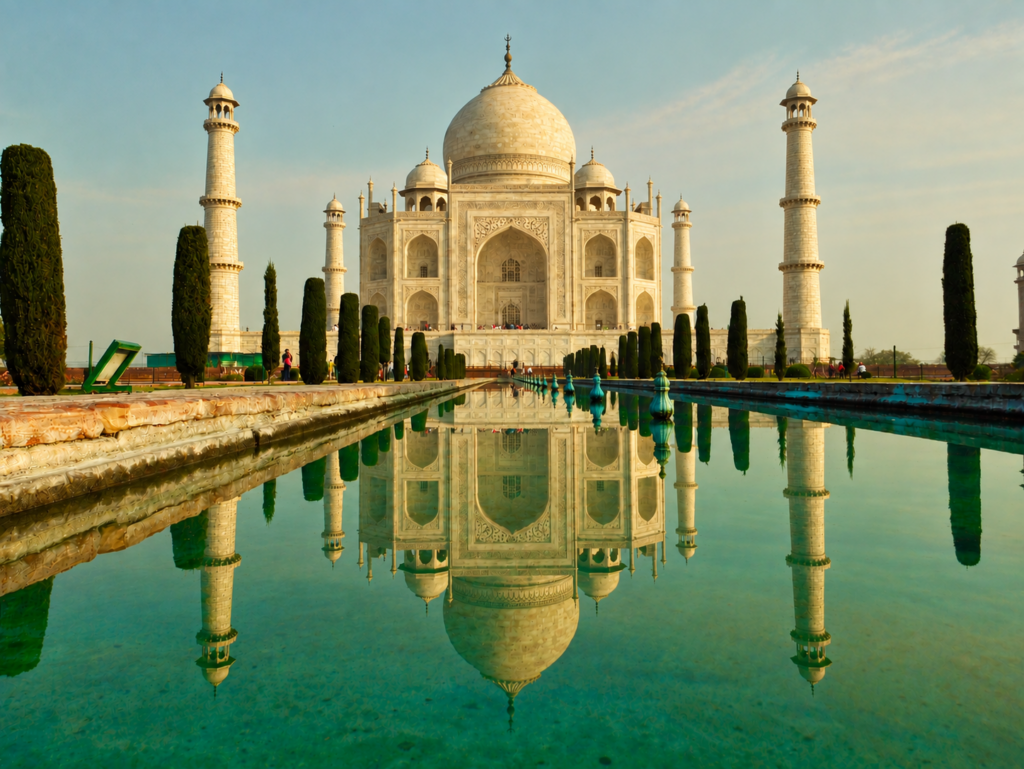
As the sun rises, the Taj seems to shift between shades of white, cream and gold. Reflections appear in the long pools leading toward the mausoleum, and—for a brief period in the morning—the entire complex feels much quieter than you’d expect from one of the world’s most visited monuments.
It was easily one of the highlights of the trip.
A Weekend Abroad tip: This is one morning when the alarm is worth it. Arrange transportation the night before and plan to arrive before sunrise rather than simply arriving at sunrise. The goal is to be inside the complex when the light begins to change.
And once you’re there, don’t rush.
Everyone wants the iconic photograph from the reflecting pool, but some of my favorite moments came from simply walking around the complex and watching the Taj Mahal change as the morning light grew stronger.