
48 Hours in Stockholm: Summer, the World Cup & an Overnight Cruise to Helsinki
There may not be a better time to visit Stockholm than the middle of summer.
The days seem endless, the city’s parks and waterfronts are full of people, and after spending much of the year dealing with cold temperatures and limited daylight, Stockholm comes alive during June and July.
I visited during the summer of 2018, in the middle of the World Cup. Sweden was making an unexpected run through the tournament, which meant our 48 hours in Stockholm included something I hadn’t necessarily planned for: watching World Cup soccer with thousands of Swedish fans in the middle of the city.
From there, we boarded an overnight ship bound for Helsinki, sailing through Stockholm’s incredible archipelago as the sun slowly disappeared behind us.
If you only have two days in Stockholm, that’s not much time—but it’s enough to understand why summer in Sweden is so special.
Day One: Gamla Stan & the Heart of Stockholm
Start in Gamla Stan
If it’s your first time in Stockholm, start with Gamla Stan, the city’s Old Town.
Stockholm is built across a collection of islands, and Gamla Stan sits right in the middle of them. It’s the oldest part of the city, dating back to the Middle Ages, with narrow cobblestone streets, colorful buildings and small squares that make it easy to forget you’re in a modern European capital.
This is one part of Stockholm where I wouldn’t worry too much about having an itinerary.
Walk.
The main streets are filled with shops and restaurants, but turn down the smaller alleys and you’ll find the Stockholm that makes Gamla Stan worth visiting.
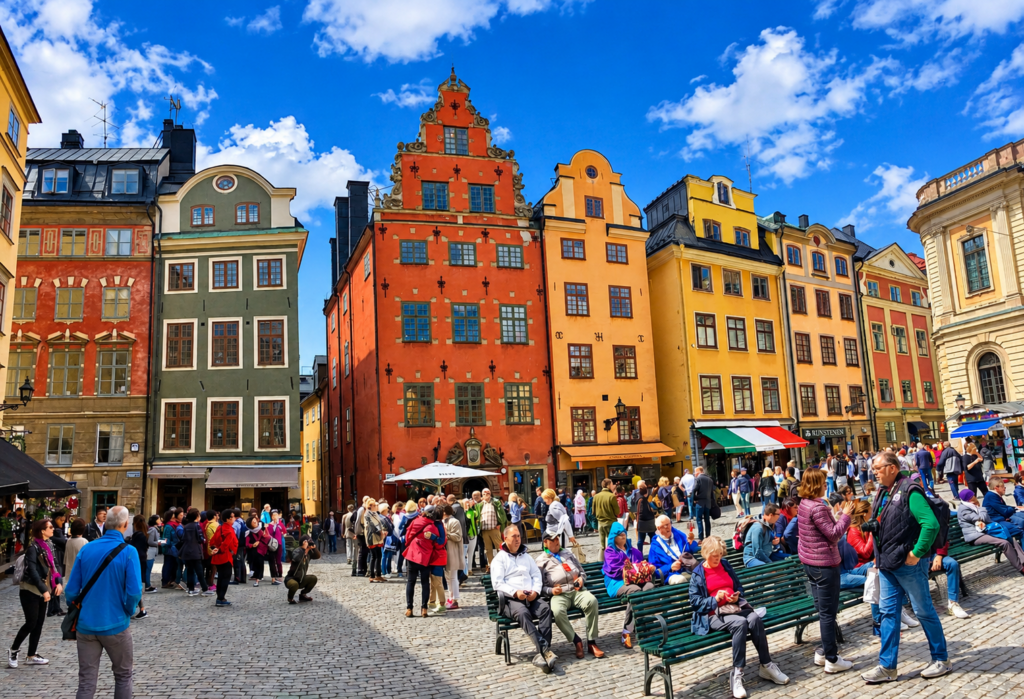
Eventually, make your way toward Stortorget, Stockholm’s oldest square and probably the most recognizable spot in Old Town. Its colorful façades are among the city’s classic photographs.
The Royal Palace
From Gamla Stan, it’s an easy walk to the Royal Palace.
The palace has more than 600 rooms and dominates the northern edge of Old Town. If you’re interested in royal history, you can spend considerable time exploring the palace and its museums. If you only have 48 hours, however, I’d keep the visit relatively short unless this is a particular interest of yours.
With limited time in Stockholm—particularly during summer—I preferred being outside.
And Stockholm is a city that practically begs you to stay outside.
Walk the Waterfront
One of Stockholm’s defining characteristics is water.
It’s everywhere.
Rather than constantly jumping onto public transportation, walk along the waterfront whenever your itinerary allows. Bridges connect the city’s islands, boats move continuously through the harbor, and seemingly every few blocks provide another view across the water.
During June and July, when daylight stretches deep into the evening, there isn’t much reason to rush back to your hotel.
Take advantage of it.
A World Cup in Stockholm
Our visit happened to coincide with the 2018 FIFA World Cup, and Sweden was having one of its best tournaments in decades.
That completely changed the atmosphere of the city.
We joined a huge crowd of Swedish supporters gathered outside to watch the match on a giant screen. Yellow Sweden jerseys were everywhere, Swedish flags filled the crowd, and for a couple of hours sightseeing became irrelevant.
We were watching the World Cup in Stockholm with the Swedes.
There’s something special about being in another country during a major international sporting event. You don’t need to support the team—or even particularly care about the sport—to appreciate it.
But as a soccer fan, I loved it.
International tournaments provide a rare window into how a country sees itself. People who otherwise have little in common suddenly gather in the same square wearing the same colors, singing the same songs and reacting collectively to every shot, tackle and goal.
For a visitor, you get to temporarily join in.
It became one of my favorite memories from Stockholm—and something no itinerary or travel guide could have planned.
Day Two: Djurgården & the Vasa
For your second morning, head toward Djurgården.
The green island feels remarkably removed from central Stockholm despite sitting just across the water. It’s part park, part cultural district and home to several of the city’s best museums, including Skansen, the Nordic Museum, ABBA The Museum and the Vasa Museum.
If you have only enough time for one museum in Stockholm, I have an easy recommendation.
The Vasa Museum
Go see the Vasa.
Even if you aren’t particularly interested in maritime history, the Vasa Museum is fascinating.
The Vasa was a massive Swedish warship that set sail in 1628—and sank on its maiden voyage before it could even escape Stockholm.
More than three centuries later, the ship was rediscovered and eventually raised from the harbor. Because of the Baltic’s unusual conditions, much of the original ship survived. Today, the enormous 17th-century vessel sits inside a museum built around it.
The scale is difficult to appreciate until you’re standing beside it.
You can walk around the ship at different levels, getting close enough to see its elaborate wooden carvings while learning how one of Sweden’s most ambitious naval projects became one of its most famous failures.
It’s one of the more unusual museums I’ve visited in Europe.
Skansen, ABBA—or Just Enjoy Djurgården
If you have additional time, Djurgården presents a dilemma.
Skansen is the world’s oldest open-air museum and offers a look at traditional Swedish life, while ABBA The Museum is exactly what you’d expect from the country that gave the world Dancing Queen.
But with only 48 hours, don’t feel obligated to spend the entire afternoon inside museums.
In summer, simply walking or biking around Djurgården is an attraction in itself.
Find somewhere outside for lunch. Have a beer. Sit by the water.
Stockholm in July isn’t a city I’d recommend experiencing entirely from inside buildings.
If You Have More Time
With only 48 hours, you’re going to leave things behind.
Stockholm City Hall is worth seeing and is famous as the setting for the annual Nobel Prize banquet. Södermalm offers a more contemporary side of Stockholm, with cafés, restaurants, shops and excellent views back toward the historic city. The waterfront path at Monteliusvägen provides one of the classic panoramas across Stockholm.
And then there’s the archipelago.
Stockholm’s archipelago consists of thousands of islands extending east toward the Baltic. With another full day, I’d take a boat and explore it properly. Destinations like Vaxholm make relatively easy excursions from the city, while some of the farther islands deserve an entire day.
Fortunately, our next destination gave us another way to see it.
Don’t Fly to Helsinki—Sail There
If you’re traveling from Stockholm to Helsinki, you could obviously fly.
Don’t.
Take the overnight ferry.
The ships connecting Stockholm and Helsinki leave in the afternoon and travel overnight across the Baltic, arriving in Finland the following morning. Cabins allow you to sleep onboard, while the ships themselves have restaurants, bars, shopping and entertainment.
But none of that is the primary reason I’d recommend it.
The departure from Stockholm is spectacular.
Sailing Through the Stockholm Archipelago
Shortly after leaving Stockholm, the ship begins weaving through the archipelago.
The city slowly disappears and is replaced by islands—some inhabited, some covered in trees, some dotted with small Swedish summer houses sitting beside the water.
In summer, you have hours of daylight to enjoy it.
Grab a drink and find a spot outside.
The ship gradually makes its way toward the open Baltic while the islands become smaller and farther apart. Eventually the sun begins its very slow Scandinavian summer descent toward the horizon.
It’s one of those travel experiences where the transportation becomes part of the trip rather than simply a way of getting somewhere.
A Scandinavian Summer Sunset
This is where visiting in June or July pays off.
Stockholm’s summer days are extraordinarily long. Even late at night, the sky can retain a lingering twilight.
That means you can have dinner aboard the ship, grab another drink and return outside—and still find light on the horizon.
Eventually, head back to your cabin and go to sleep somewhere in the Baltic Sea.
When you wake up, you’re approaching Finland.
Morning in Helsinki
There is something inherently satisfying about going to sleep in one country and waking up in another.
Instead of airports, security lines and baggage claims, you wake up, shower, grab some coffee and walk outside as Helsinki comes into view.
The overnight ferry effectively combines a hotel room and transportation while giving you one of the best sightseeing experiences of the trip.
It’s an especially good way to connect the two cities if you’re building a larger Scandinavian or Baltic itinerary.
Stockholm → overnight ferry → Helsinki just works.
The Perfect 48 Hours in Stockholm
If I had exactly two days in Stockholm during the summer, I’d keep the itinerary simple:
Day One: Gamla Stan → Stortorget → Royal Palace → waterfront → explore central Stockholm → dinner and drinks outside.
Day Two: Djurgården → Vasa Museum → lunch outside → Skansen or ABBA Museum if time allows → return to the waterfront → board the overnight ferry to Helsinki.
And if Sweden happens to be playing in the World Cup?
Throw the itinerary away for a couple of hours and find the biggest screen and crowd you can.
Final Thoughts
Stockholm surprised me.
There are grander European capitals. There are cities with more famous monuments, larger museums and longer lists of things you’re told you absolutely have to see.
Stockholm’s appeal is different.
It’s the relationship between the city and the water. It’s Gamla Stan’s narrow streets opening unexpectedly onto the harbor. It’s sitting outside late in the evening and realizing the sun still hasn’t completely disappeared.
For us, it was also thousands of people dressed in yellow, watching Sweden play in the World Cup on a giant screen in the middle of the city.
And then, just as our 48 hours were ending, we boarded a ship.
Stockholm faded into the distance behind us, we spent the evening sailing through the islands, and the next morning we woke up in Helsinki.
If you only have 48 hours in Stockholm, summer is the time to do it—and leaving by sea may be the best final view of the city you’ll get.


